Health Gorilla
Health Gorilla is a digital healthcare interoperability platform that provides real-time access to connected clinical data, enabling scalable, intelligent, and data-driven healthcare products.
Health Gorilla
Health Gorilla is a digital healthcare interoperability platform that provides real-time access to connected clinical data, enabling scalable, intelligent, and data-driven healthcare products.
COMPANY
Health Gorilla
Role
Senior Product Designer
COMPANY
Health Gorilla
Role
Senior Product Designer
COMPANY
Health Gorilla
Role
Senior Product Designer

Product Discovery
Understanding the business goal.
As healthcare organizations across the United States and Canada adopted the platform to access patient data and clinical workflows within ecosystems connected to thousands of healthcare institutions across North America, we focused on understanding how clinicians interacted with fragmented patient information in real-world scenarios.
The goal was to improve usability, reduce cognitive load, and enable scalable adoption across complex healthcare environments.
Objectives
Identify real usage and behavioral patterns among clinical professionals.
Reduce friction when navigating fragmented clinical data.
Improve clarity and speed across critical healthcare workflows.
Enable scalable adoption across clinics, laboratories, and hospitals.
Insight & Pain point
Through UX Research sessions, interviews, and usability testing with healthcare providers and organizations integrated into the healthcare ecosystem, we identified a critical gap in how clinicians interacted with patient data.
While professionals valued having access to comprehensive clinical information, the experience became fragmented and difficult to navigate in high-pressure scenarios, especially during emergency situations or critical diagnoses.
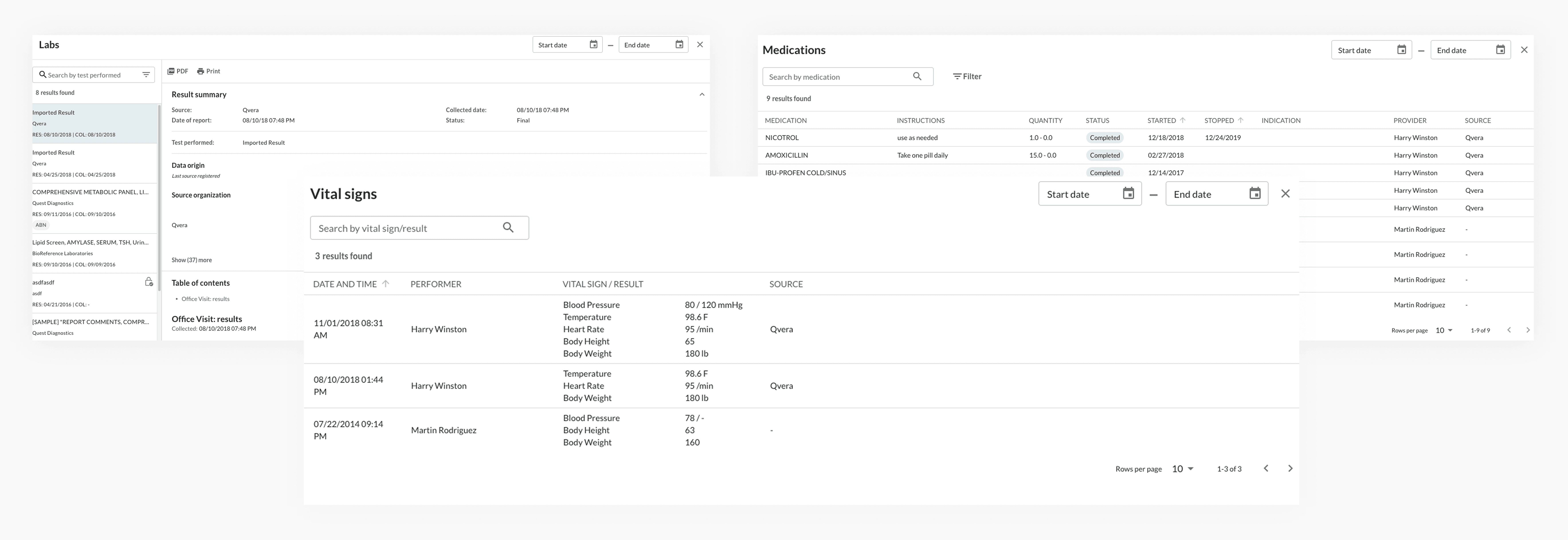
Instead of navigating across multiple modules — each with its own filters and structures — clinicians needed a single, integrated view that allowed them to quickly understand the patient’s context.
One key insight emerged during the research:
Clinicians do not explore information broadly during critical moments — they focus on a specific condition or diagnosis.
For example, during a cardiac event, clinicians need immediate access to all relevant information — including labs, medications, clinical encounters, and vital signs — connected to that diagnosis, without constantly switching contexts.
Approach (Design Thinking)
1. UX sessions and stakeholder alignment.
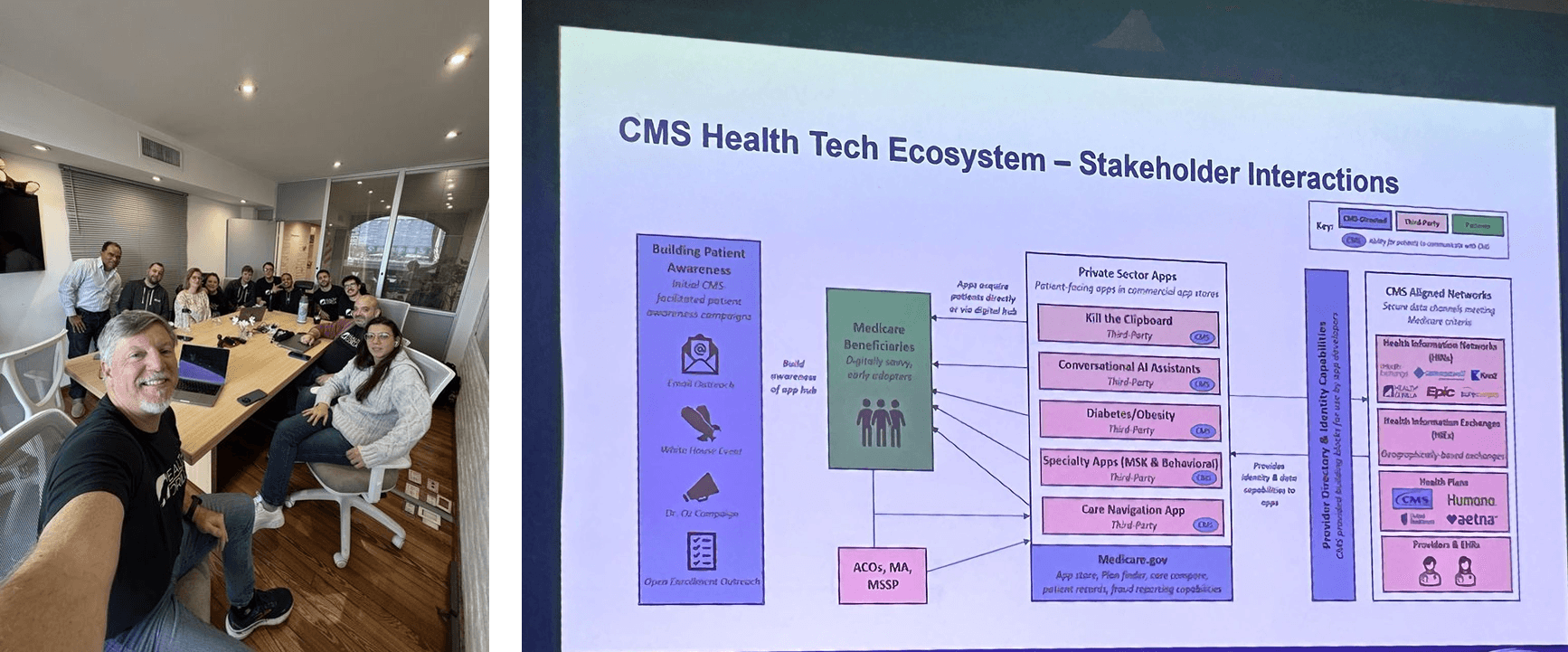
We collaborated with clinical professionals, Product Managers, and business stakeholders to observe real-world workflows, understand user behavior patterns, and identify key pain points across the experience.
2. Journey Mapping and workflow analysis.
We mapped how providers accessed, interpreted, and navigated across multiple clinical data sources to identify friction points, context switching, and opportunities for optimization.
3. Research synthesis and pain point identification.
Based on research analysis and workflow evaluation, we identified the main friction points:
High cognitive load
Fragmented clinical information views
Lack of visual hierarchy and contextual clarity
Complex navigation across modules and filters
4. Rapid prototyping and iteration.
We explored different interaction models through wireframes, prototypes, and iterative user validations to evaluate clarity, efficiency, and usability within critical clinical scenarios.
Design Solution
Designing the experience.
Solution
An AI-powered clinical chat complements the visualization by allowing providers to narrow the view through natural-language queries — surfacing relevant diagnoses, lab results, medications, procedures, encounters, and other critical clinical information. In an ER scenario, this helps providers move from a broad longitudinal record to the information most relevant to the patient’s current condition.
Clarity over density → Simplifying large and complex clinical datasets into meaningful information.
Contextual navigation → Connecting diagnoses, labs, medications, encounters, and other related clinical information.
AI-assisted exploration → Allowing providers to ask questions and dynamically narrow the patient view based on the clinical context.
Progressive disclosure → Surfacing critical information first while keeping deeper clinical details accessible when needed.
Systems thinking → Aligning interactions and components with the design system to create a consistent and scalable experience.
Outcome
Clinicians can now enter the experience with a specific focus and instantly access all relevant information in a single place, enabling faster understanding and more efficient, confident decision-making during critical moments.
Impact
Optimized clinical interpretation → Reduced cognitive load through a more contextual and integrated experience.
High module adoption → Drove 80%+ recurring usage across a network of 1,500+ clinics and healthcare organizations in the US and Canada.
Ecosystem scalability → Supported large volumes of data and multiple interoperable sources.
Product Discovery
Understanding the business goal.
As healthcare organizations across the United States and Canada adopted the platform to access patient data and clinical workflows within ecosystems connected to thousands of healthcare institutions across North America, we focused on understanding how clinicians interacted with fragmented patient information in real-world scenarios.
The goal was to improve usability, reduce cognitive load, and enable scalable adoption across complex healthcare environments.
Objectives
Identify real usage and behavioral patterns among clinical professionals.
Reduce friction when navigating fragmented clinical data.
Improve clarity and speed across critical healthcare workflows.
Enable scalable adoption across clinics, laboratories, and hospitals.
Insight & Pain point
Through UX Research sessions, interviews, and usability testing with healthcare providers and organizations integrated into the healthcare ecosystem, we identified a critical gap in how clinicians interacted with patient data.
While professionals valued having access to comprehensive clinical information, the experience became fragmented and difficult to navigate in high-pressure scenarios, especially during emergency situations or critical diagnoses.
Instead of navigating across multiple modules — each with its own filters and structures — clinicians needed a single, integrated view that allowed them to quickly understand the patient’s context.
One key insight emerged during the research:
Clinicians do not explore information broadly during critical moments — they focus on a specific condition or diagnosis.
For example, during a cardiac event, clinicians need immediate access to all relevant information — including labs, medications, clinical encounters, and vital signs — connected to that diagnosis, without constantly switching contexts.
Approach (Design Thinking)
1. UX sessions and stakeholder alignment.
We collaborated with clinical professionals, Product Managers, and business stakeholders to observe real-world workflows, understand user behavior patterns, and identify key pain points across the experience.
2. Journey Mapping and workflow analysis.
We mapped how providers accessed, interpreted, and navigated across multiple clinical data sources to identify friction points, context switching, and opportunities for optimization.
3. Research synthesis and pain point identification.
Based on research analysis and workflow evaluation, we identified the main friction points:
High cognitive load
Fragmented clinical information views
Lack of visual hierarchy and contextual clarity
Complex navigation across modules and filters
4. Rapid prototyping and iteration.
We explored different interaction models through wireframes, prototypes, and iterative user validations to evaluate clarity, efficiency, and usability within critical clinical scenarios.
Design Solution
Designing the experience.
Solution
An AI-powered clinical chat complements the visualization by allowing providers to narrow the view through natural-language queries — surfacing relevant diagnoses, lab results, medications, procedures, encounters, and other critical clinical information. In an ER scenario, this helps providers move from a broad longitudinal record to the information most relevant to the patient’s current condition.
Clarity over density → Simplifying large and complex clinical datasets into meaningful information.
Contextual navigation → Connecting diagnoses, labs, medications, encounters, and other related clinical information.
AI-assisted exploration → Allowing providers to ask questions and dynamically narrow the patient view based on the clinical context.
Progressive disclosure → Surfacing critical information first while keeping deeper clinical details accessible when needed.
Systems thinking → Aligning interactions and components with the design system to create a consistent and scalable experience.
Outcome
Clinicians can now enter the experience with a specific focus and instantly access all relevant information in a single place, enabling faster understanding and more efficient, confident decision-making during critical moments.
Impact
Optimized clinical interpretation → Reduced cognitive load through a more contextual and integrated experience.
High module adoption → Drove 80%+ recurring usage across a network of 1,500+ clinics and healthcare organizations in the US and Canada.
Ecosystem scalability → Supported large volumes of data and multiple interoperable sources.
Product Discovery
Understanding the business goal.
As healthcare organizations across the United States and Canada adopted the platform to access patient data and clinical workflows within ecosystems connected to thousands of healthcare institutions across North America, we focused on understanding how clinicians interacted with fragmented patient information in real-world scenarios.
The goal was to improve usability, reduce cognitive load, and enable scalable adoption across complex healthcare environments.
Objectives
Identify real usage and behavioral patterns among clinical professionals.
Reduce friction when navigating fragmented clinical data.
Improve clarity and speed across critical healthcare workflows.
Enable scalable adoption across clinics, laboratories, and hospitals.
Insight & Pain point
Through UX Research sessions, interviews, and usability testing with healthcare providers and organizations integrated into the healthcare ecosystem, we identified a critical gap in how clinicians interacted with patient data.
While professionals valued having access to comprehensive clinical information, the experience became fragmented and difficult to navigate in high-pressure scenarios, especially during emergency situations or critical diagnoses.
Instead of navigating across multiple modules — each with its own filters and structures — clinicians needed a single, integrated view that allowed them to quickly understand the patient’s context.
One key insight emerged during the research:
Clinicians do not explore information broadly during critical moments — they focus on a specific condition or diagnosis.
For example, during a cardiac event, clinicians need immediate access to all relevant information — including labs, medications, clinical encounters, and vital signs — connected to that diagnosis, without constantly switching contexts.
Approach (Design Thinking)
1. UX sessions and stakeholder alignment.
We collaborated with clinical professionals, Product Managers, and business stakeholders to observe real-world workflows, understand user behavior patterns, and identify key pain points across the experience.
2. Journey Mapping and workflow analysis.
We mapped how providers accessed, interpreted, and navigated across multiple clinical data sources to identify friction points, context switching, and opportunities for optimization.
3. Research synthesis and pain point identification.
Based on research analysis and workflow evaluation, we identified the main friction points:
High cognitive load
Fragmented clinical information views
Lack of visual hierarchy and contextual clarity
Complex navigation across modules and filters
4. Rapid prototyping and iteration.
We explored different interaction models through wireframes, prototypes, and iterative user validations to evaluate clarity, efficiency, and usability within critical clinical scenarios.
Design Solution
Designing the experience.
Solution
An AI-powered clinical chat complements the visualization by allowing providers to narrow the view through natural-language queries — surfacing relevant diagnoses, lab results, medications, procedures, encounters, and other critical clinical information. In an ER scenario, this helps providers move from a broad longitudinal record to the information most relevant to the patient’s current condition.
Clarity over density → Simplifying large and complex clinical datasets into meaningful information.
Contextual navigation → Connecting diagnoses, labs, medications, encounters, and other related clinical information.
AI-assisted exploration → Allowing providers to ask questions and dynamically narrow the patient view based on the clinical context.
Progressive disclosure → Surfacing critical information first while keeping deeper clinical details accessible when needed.
Systems thinking → Aligning interactions and components with the design system to create a consistent and scalable experience.
Outcome
Clinicians can now enter the experience with a specific focus and instantly access all relevant information in a single place, enabling faster understanding and more efficient, confident decision-making during critical moments.
Impact
Optimized clinical interpretation → Reduced cognitive load through a more contextual and integrated experience.
High module adoption → Drove 80%+ recurring usage across a network of 1,500+ clinics and healthcare organizations in the US and Canada.
Ecosystem scalability → Supported large volumes of data and multiple interoperable sources.